The Hook: The "Context Amnesia" Trap
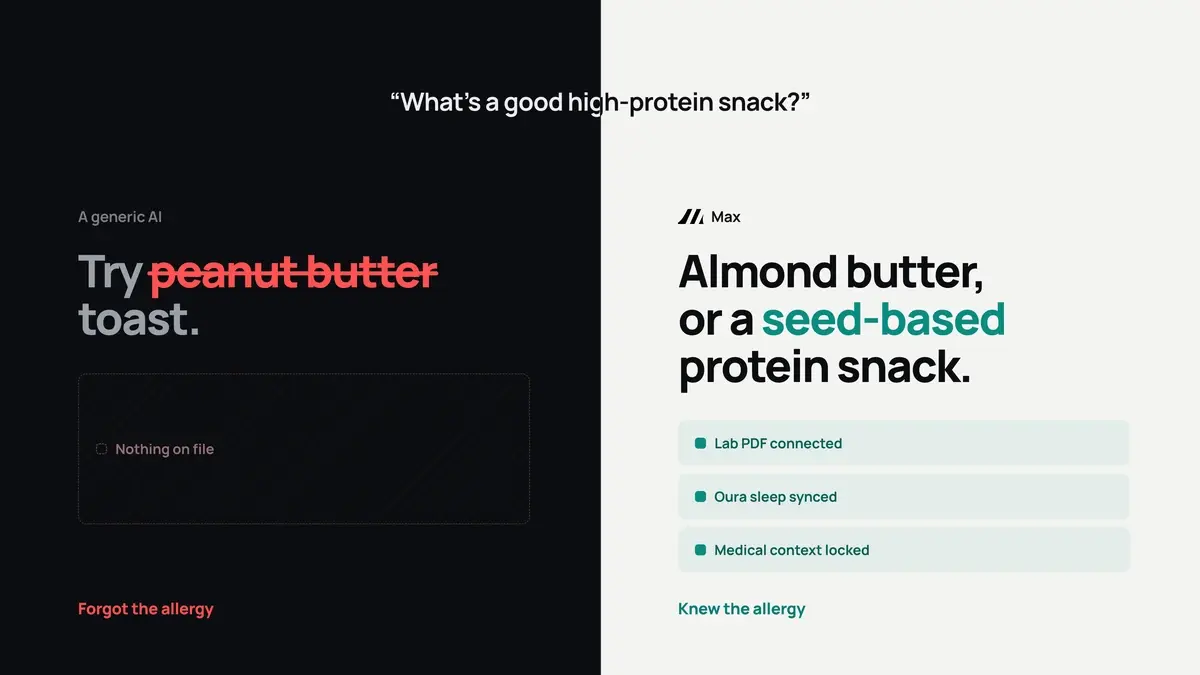
Picture this. Someone tells their AI chatbot, in plain language, that they have a severe peanut allergy. A few messages later, in a completely different part of the conversation, they ask for a quick high protein snack idea. The chatbot suggests peanut butter toast.
This isn't a hypothetical. It's become a genuine trend across TikTok and Instagram, where people deliberately test general purpose AI chatbots by stating a life threatening allergy and then circling back to ask for a recipe or snack built around the exact ingredient they said they couldn't touch. Clip after clip shows the same pattern: the bot answers the second question as if the first one never happened.
That's the joke. But it's also the warning.
Standard large language models work prompt by prompt. At their core, they're predicting the next likely word based on patterns learned from the internet, not from a stored, structured picture of your medical history. In casual use, that's a minor annoyance. In health and fitness, where the advice touches what you eat, how hard you train, and what your body can safely handle, an AI that forgets what you told it three messages ago isn't just unhelpful. It's a real safety gap.
The 3 Structural Flaws of General AI Chatbots
The peanut butter example is memorable, but it points to something bigger than one missed allergy. Generic AI chatbots share three structural weaknesses that make them a poor foundation for health and fitness guidance.
No Unshakeable Context
Generic AI suffers from what's best described as context amnesia. It doesn't lock in your long term restrictions the way a real coach or clinician would. Allergies, joint issues, chronic conditions, past injuries, none of it is treated as permanent, protected data. It's just more text in a conversation that eventually scrolls out of relevance. Ask the same chatbot the same health question in a new session, and you're starting from zero every time.
Zero Baseline Awareness
A 22 year old athlete and a 45 year old managing prediabetes or hypothyroidism are not the same person with different numbers. They have different metabolic realities, different risk profiles, and different limits on what "aggressive" training or dieting actually means for their body. Generic AI tends to hand both of them the same generic 2,000 calorie diet and the same 10,000 step target, because it has no baseline understanding of who it's actually talking to.
No Medical Grounding
Ask a general chatbot for nutrition or fitness advice, and it's often drawing from forum posts, blog trends, and whatever ranked well in search results during training. There's no clinical guardrail sitting underneath the answer. No lab markers. No real time biometrics. It sounds confident because that's what the model is optimized to do, not because the advice is actually grounded in your health data.
Grounded AI: How Max AI Fixes the Hallucination Problem
This is where Max AI, the AI health coach built into Maxiom, takes a different approach. Instead of trying to be a broad, do everything generator, Max AI is built as a context locked coach that remembers who you are and adjusts around it every time you open the app.
Medical Profile and Conditions Your allergies, injuries, and existing conditions aren't just mentioned once and forgotten. They're stored as permanent safety guardrails. That means automatic filtering of allergens from suggestions, and workouts that adapt around a bad knee or high blood pressure by default, not by chance.
Lab Results and Blood Work Most people get blood work done and never look at it again beyond a quick glance at what's flagged red. Max AI reads actual blood panel PDFs and turns raw, confusing numbers into daily micro habits you can actually act on, instead of letting that data sit unread in a patient portal. This same profile also picks up what you eat day to day. If you want to see how that side works, our guide on AI meal logging walks through how Max AI estimates calories and macros from a simple photo.
Wearable Integration Max AI continuously syncs with Apple Watch, Oura, Whoop, Garmin, and Fitbit to track sleep, heart rate, and HRV. When recovery data shows you're running on empty, it scales back training intensity automatically, rather than pushing the same fixed plan regardless of how your body is actually doing that day. We go deeper into how this plays out day to day in Adaptive Recovery Nutrition, which covers how Max AI adjusts meals and workouts around sleep, fatigue, and injuries.
Head to Head Comparison
Scenario A: Dietary Restriction and Insulin Sensitivity
Generic AI: "Try eating whole grains and fruit smoothies!" This kind of advice sounds healthy on the surface but ignores post meal blood sugar spikes entirely. For someone managing insulin resistance, a fruit heavy smoothie can trigger exactly the kind of spike they're trying to avoid.
Max AI: Adjusts macro targets specifically around your insulin resistance data and your recent meal logs, so the recommendation reflects how your body actually responds, not a generic wellness talking point.
Scenario B: Exercise With a Past Injury
Generic AI: "Do 5 sets of heavy squats today." No memory of any past injury, no awareness of how you slept last night, just a generic strength training prescription.
Max AI: Recalls your lumbar spine injury, checks last night's recovery data from your wearable, sees that sleep and HRV are low, and shifts today's focus to low impact mobility work instead of loading your spine on a day your body isn't ready for it. This is the same adaptive logic behind Adaptive Recovery Nutrition, where rest day meals and training plans shift automatically based on how your body is actually recovering.
The Bottom Line
True personalization in health and fitness isn't a clever prompt or a longer chat history. It requires persistent, structured data that carries across every single interaction, your conditions, your labs, your recovery, your history. That's the gap generic AI chatbots can't close, and it's the exact problem Max AI was built to solve.
If you've ever gotten advice from an AI chatbot that felt like it was talking to a stranger instead of you, that's context amnesia in action. Log into Maxiom, set up your baseline profile, and start a conversation with Max that actually remembers who you are. You can also see the full picture of how the coaching works on our How It Works page, or learn more about the team behind it on the About Maxiom page.
Frequently Asked Questions
Can AI chatbots give dangerous health advice?
Yes. General purpose AI chatbots generate responses based on patterns in text, not a stored medical profile. Without persistent context, they can suggest foods, supplements, or workouts that directly conflict with a person's allergies, medications, or existing conditions, even after being told about them earlier in the same conversation.
Why does AI forget things I told it earlier in the chat?
Most general AI chatbots process conversations prompt by prompt and don't permanently store personal health details as protected data. Once a detail like an allergy or injury scrolls further back in the conversation, it's treated as less relevant, which is why the same chatbot can contradict itself within a single session.
How is an AI health coach different from a general AI chatbot?
An AI health coach like Max AI is built around a locked, persistent medical and fitness profile. Instead of generating a fresh, generic answer each time, it references your allergies, conditions, lab results, and wearable data on every interaction, so recommendations are grounded in your actual health picture rather than general internet text.
Can AI read and interpret my blood test results?
Max AI can read uploaded blood panel PDFs and translate the raw lab markers into practical, everyday habits. This turns lab work that would otherwise sit unread into specific, actionable guidance tied to your actual numbers.
Is it safe to rely on AI for personalized nutrition advice?
It depends entirely on whether the AI is grounded in your actual health data. Generic AI nutrition advice is built for a general audience and can miss critical factors like insulin sensitivity or allergies. A grounded system that references your medical profile, labs, and recovery data before making a recommendation is a fundamentally safer approach to AI nutrition advice.