You have probably looked at your sleep data and felt slightly confused. Your watch says you got two hours of Core sleep and forty minutes of Deep. An article says there are three NREM stages called N1, N2 and N3. A friend on a different device talks about Light sleep. None of these words appear to describe the same thing.
They mostly do. The labels come from two different systems that nobody bothers to reconcile for you, and the confusion is entirely reasonable.
This guide covers what the stages of sleep actually are, what happens in each one, and how the clinical model maps onto whatever your device is showing you tonight.
The four stages of sleep
Sleep researchers divide sleep into four stages. Three of them are non-rapid eye movement sleep, abbreviated NREM, and one is rapid eye movement sleep, or REM.
The current clinical naming comes from the American Academy of Sleep Medicine, which in 2007 consolidated an older five-stage system into the four we use today. If you find an older source referring to Stage 3 and Stage 4 as separate things, that is why. They were merged.
Stage N1: the transition into sleep This is the shallowest stage, the few minutes between being awake and being properly asleep. It usually lasts one to seven minutes and accounts for roughly 5% of a night. Muscle activity slows, and this is where hypnic jerks happen, that sudden falling sensation that yanks you back awake. Wake someone during N1 and they will often insist they were not asleep at all.
Stage N2: the bulk of your night N2 is where you spend most of your sleep, typically 45% to 55% of total sleep time. Body temperature drops, heart rate slows, and brain activity shows distinctive bursts called sleep spindles that are associated with consolidating what you learned during the day. Individual N2 periods run around 10 to 25 minutes early in the night and get longer as the night goes on.
Stage N3: deep, slow-wave sleep This is the stage people mean when they say deep sleep. It makes up roughly 15% to 25% of a night in healthy adults and is the hardest stage to be woken from. If you have ever been woken and felt genuinely disoriented for several minutes, you were probably in N3.
Physically, this is the repair shift. Growth hormone release peaks, tissue repair happens, and the immune system does much of its maintenance. N3 is heavily concentrated in the first half of the night, which matters more than most people realise. Going to bed two hours late does not shift your deep sleep later. It cuts into it.
REM sleep: the active brain REM accounts for about 20% to 25% of adult sleep. Brain activity looks close to waking, your eyes move rapidly beneath closed lids, and most vivid dreaming happens here. Your body is temporarily paralysed, which is a protective mechanism that stops you acting out dreams.
REM is associated with emotional processing and memory consolidation. Unlike deep sleep, REM is back-loaded. Your first REM period arrives roughly 90 minutes after you fall asleep and might last only ten minutes. By the final cycle before waking, a REM period can run close to an hour.
How the stages fit into a cycle
You do not move through these stages once. You cycle through them repeatedly, with each cycle lasting somewhere between 90 and 120 minutes. Most adults complete four to six cycles a night.
The cycles are not identical, and this is the part most explanations skip:
Early cycles are deep-sleep heavy: The first two cycles of the night carry the majority of your N3. Physical recovery is front-loaded.
Later cycles are REM heavy: As the night progresses, N3 shrinks and REM expands. Cognitive and emotional processing is back-loaded.
The practical consequence is that cutting sleep short at either end costs you something different. A late bedtime with a fixed alarm costs you deep sleep and physical recovery. An early alarm after a normal bedtime costs you REM. Both show up as "not enough sleep" on a total-hours basis, but they are not the same deficit, and they do not feel the same the next day.
Why your wearable uses different words
Here is the thing nobody explains. Consumer devices do not use clinical labels, and they do not all use the same labels as each other.
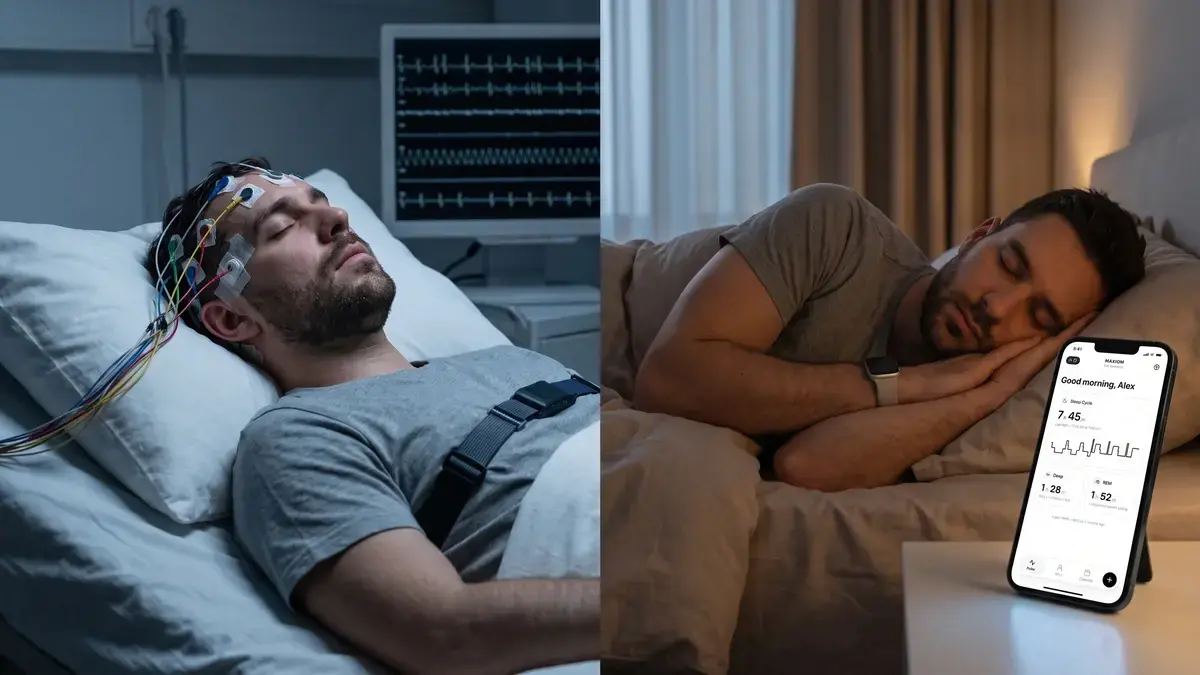
The reason is technical. Clinical sleep staging is done with polysomnography, which measures brain waves directly using EEG along with eye movement and muscle activity. Your watch cannot see brain waves. It infers stages from movement, heart rate, and heart rate variability, then runs that through an algorithm.
That inference is good at some things and weaker at others. Wearables are generally reliable at distinguishing sleep from wake and at estimating total sleep duration. They are considerably less precise at classifying individual stages, and this is well documented in validation research. Because devices cannot reliably separate N1 from N2, most of them merge the two into a single category.
Here is roughly how the labels map:
Apple Health and Apple Watch: Awake, Core, Deep, REM. Core combines N1 and N2. Deep corresponds to N3.
Oura: Awake, Light, Deep, REM. Light combines N1 and N2.
Whoop: Awake, Light, SWS, REM. SWS stands for slow-wave sleep and is N3.
Garmin: Awake, Light, Deep, REM. Same structure as Oura and Fitbit.
Fitbit: Awake, Light, Deep, REM.
So Core, Light, and N1 plus N2 are the same thing under three names. Deep, SWS, and N3 are the same thing under three names. Apple is the outlier for calling Light sleep Core, which is where a lot of the confusion online comes from.
Awake, incidentally, is not a sleep stage. Devices display it because brief awakenings are normal and worth seeing, but it is not part of the four-stage model no matter how your dashboard lays it out.
What to do with your stage data
Once the labels make sense, the more useful question is what any of it should change.
Look at trends, not single nights. One night with low deep sleep tells you almost nothing. Your stage distribution varies naturally, and the algorithm has error built in. A two-week trend moving in one direction is a signal. Tuesday is noise.
Deep sleep responds to timing more than effort. Since N3 concentrates early, the most reliable lever on deep sleep is a consistent and reasonably early bedtime rather than anything you do in the bedroom.
REM responds to your wake time and to alcohol. Cutting the last hour of sleep disproportionately removes REM. Alcohol is also well established as a REM suppressant, which is why a nightcap can produce eight hours of sleep that leaves you flat.
Age changes the baseline. Deep sleep declines steadily with age. Comparing your N3 percentage to a twenty-two year old's is not a meaningful exercise.
This is the point where raw numbers stop being useful on their own. Knowing you got 12% deep sleep does not tell you whether that is a problem for you, or what caused it, or what to change.
Where Max AI fits
Max AI reads your sleep data from whichever wearable you use, whether that is Apple Watch, Oura, Whoop, Garmin, or Fitbit, and normalises the labels so you are not translating between systems yourself.
More usefully, it holds the context that a stage chart cannot. It knows your baseline rather than a population average, so it can tell you whether last night was unusual for you specifically. It carries your persistent health profile and any conditions you have recorded, and it can read lab work and blood panels you upload, which matters because several ordinary explanations for disrupted sleep architecture show up in bloodwork rather than in a sleep chart.
Ask a general AI chatbot why your deep sleep dropped and it will give you a list of common causes, because a list is all it can give. It has no idea what your normal is, what you trained yesterday, what you ate, or what your last panel said. Max AI answers the same question against your own data.
That connects to recovery more broadly. If you are working out how sleep quality interacts with training load and what you eat around it, our guide to adaptive recovery nutrition covers the nutrition side, and AI meal logging explains how Max AI builds the food context that feeds those recommendations.
Frequently Asked Questions
What are the four stages of sleep?
Sleep is divided into four stages: three non-REM stages called N1, N2 and N3, plus REM sleep. N1 is the brief transition between wakefulness and sleep and makes up around 5% of the night. N2 is the bulk of your sleep at roughly 45% to 55%, and it is where memory consolidation is thought to happen. N3 is deep, slow-wave sleep, where physical repair and immune maintenance are concentrated, and REM is where brain activity resembles waking and most vivid dreaming occurs. The current four-stage model comes from the American Academy of Sleep Medicine, which merged the older Stage 3 and Stage 4 into a single N3 in 2007.
How long is one sleep cycle?
A full sleep cycle runs roughly 90 to 120 minutes, and most adults complete four to six of them per night. The cycles are not identical to each other, which is the part most explanations leave out. Early cycles carry the majority of your deep sleep, so physical recovery is front-loaded into the first half of the night. Later cycles contain progressively more REM, so a first REM period might last ten minutes while the last one before waking can run close to an hour.
Is Core sleep the same as light sleep?
Yes. Core is Apple's name for the category that Oura, Fitbit, Garmin and Whoop all call Light sleep, and both correspond to the clinical stages N1 and N2 combined. Consumer devices merge those two stages because they infer sleep stages from movement and heart rate rather than measuring brain activity, and that data cannot reliably tell N1 from N2. Apple being the only major brand to use a different word is a large part of why this question comes up so often.
Is deep sleep the same as REM sleep?
No, and in several respects they are close to opposites. Deep sleep is stage N3, characterised by very slow brain waves, difficulty waking, peak growth hormone release and tissue repair. REM involves brain activity that looks much closer to being awake, rapid eye movement, temporary muscle paralysis, and is associated with dreaming, emotional processing and memory consolidation. They are also distributed differently across the night: deep sleep clusters in the first half, while REM periods lengthen toward morning.
How much deep sleep should I get?
Deep sleep typically accounts for around 15% to 25% of total sleep time in healthy adults, but individual variation is wide enough that a target percentage is not very useful on its own. Deep sleep also declines steadily with age, so comparing your figure to a twenty-two year old's tells you little. Your own trend over two weeks or more is far more informative than any single night or any population average. If you want to influence it, bedtime timing is the strongest lever, since N3 concentrates early and a late night cuts into it rather than shifting it later.
Are sleep stage readings from a smartwatch accurate?
Partly. Wearables are reasonably reliable at estimating total sleep time and at telling sleep apart from wake, and validation research generally supports them on those measures. They are considerably less precise at classifying individual stages, because they infer stages from movement, heart rate and heart rate variability rather than measuring brain waves the way clinical polysomnography does with EEG. Treat stage percentages as approximate, ignore single-night swings, and watch the direction of the trend instead.
Why does my sleep data look different on two devices?
Different manufacturers use different sensors, different algorithms and different label sets, so two devices worn on the same night will frequently disagree about the exact split. This is expected behaviour rather than a malfunction or a sign that one device is broken. It also means comparing your numbers against a friend on a different brand is not a meaningful exercise. Pick one device, stay with it, and compare your data against your own history rather than against another system.