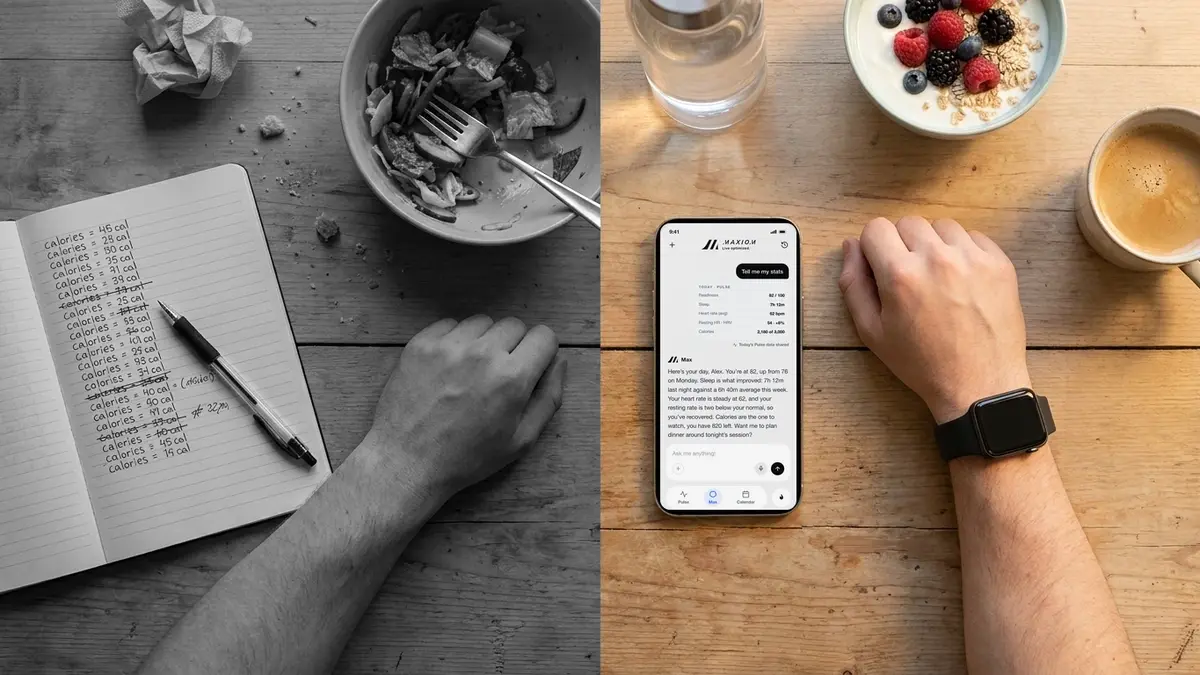
The best alternative to MyFitnessPal in 2026 is Maxiom, an AI health and fitness app built around a personal coach called Max. MyFitnessPal is mainly a food logger with nutrition advice added on top. Maxiom connects your food, workouts, sleep and wearable data, and Max uses all of it to adjust your meals and training every day.
In one line: MyFitnessPal tells you what you ate. Max tells you what to do next, and why.
If you have ever logged every meal for a month, hit your calorie target and still felt stuck, that gap is exactly what Maxiom is built to close.
MyFitnessPal vs Maxiom at a Glance
- What MyFitnessPal does best: food logging, backed by one of the largest food databases in the world.
- What Maxiom does best: coaching. Max reads your nutrition, workouts, sleep and wearable data together and changes your plan when your body needs it.
- AI coaching: MyFitnessPal's AI Coach is nutrition only and paid only. Max covers meals, workouts and recovery, and free users can talk to him every day.
- Wearable data: MyFitnessPal syncs activity from your devices. Maxiom turns HRV, sleep and calorie data into a daily score through Pulse, and Max acts on it.
- Workouts: Max builds and adjusts your training. MyFitnessPal is mainly a place to log the exercise you already did.
- Price: Maxiom Unlimited is $23.99 a month or $179.99 a year. MyFitnessPal Premium is $19.99 a month or $79.99 a year, and Premium+ is $24.99 a month or $99.99 a year.
| MyFitnessPal | Maxiom | |
|---|---|---|
| Main focus | Calorie and macro tracking | AI coaching across food, training and recovery |
| AI coach | Nutrition only, Premium and Premium+ only | Max covers meals, workouts and recovery, on free and paid plans |
| Workout plans | Logging focus | Max builds and adjusts them |
| Wearable insights | Syncs activity and steps | Pulse reads HRV, sleep and calories into one score |
| Remembers your health context | Works from your food logs and goals | Max keeps your goals, injuries, conditions and medications in mind |
| Free plan | Unlimited food search, with ads, no barcode scan | Daily Max chats and meal logs, plus Pulse |
| Monthly price | $19.99 (Premium), $24.99 (Premium+) | $23.99 (Unlimited) |
| Yearly price | $79.99 (Premium), $99.99 (Premium+) | $179.99 (Unlimited) |
| Free trial | Varies by offer | 3 days on monthly and yearly |
Prices checked in October 2026 from public listings. Both apps change offers often, so check the app store before you pay.
Why People Look for a MyFitnessPal Alternative
MyFitnessPal has been around since 2005 and is still the default calorie counter for millions of people. Most people who leave it are not unhappy with the food database. They leave for one of four reasons.
Features moved behind the paywall: In October 2022, MyFitnessPal moved barcode scanning to Premium, and custom macro goals now sit there too. The free version still logs food, but it feels limited and carries ads.
Logging is not the same as progress: A food diary tells you what happened. It does not tell you why your weight has stalled, why you feel flat in the gym or what to change tomorrow.
Nutrition is only one part of the picture: How you sleep, how hard you train and how well you recover all affect your results. A tool that only sees your plate misses most of that.
The advice feels generic: Advice built only from food logs and calorie targets cannot account for a bad night of sleep, a knee injury or a medication that changes your heart rate.
What Makes Maxiom the Best MyFitnessPal Alternative
Max Is a Coach, Not a Search Box
Max is the AI coach at the centre of Maxiom. He works more like a training partner who knows your history than a tracker you report to. Tell him what you ate, ask him what to have for dinner or ask why your progress has slowed, and he answers using your own data.
MyFitnessPal added an AI Coach in June 2026, and it is a real step forward for food advice. It is built on your food logs, though, and it is only available on paid plans. Max looks at your meals, training, sleep and recovery together, so his answers cover the whole day and not only what is on your plate.
He Plans Your Workouts as Well as Your Meals
With MyFitnessPal, most people use a second app for training. With Maxiom, Max handles both. He builds your workouts around your goal, then adjusts them as you go. If you are tired, he eases the session. If you are recovering well, he lets you push.
Because the same coach plans your food and your training, the two stay in step. A hard leg day gets the meals to support it, which is the idea behind adaptive recovery nutrition.
Pulse Turns Your Wearable Data Into Action
Maxiom connects with Apple Watch, Oura, Whoop, Garmin and Fitbit. Through Pulse, it reads your heart rate variability, resting heart rate, sleep, steps, training load and calories, then combines them into one score from 1 to 100 called Body's Maximum Potential.
You do not have to work out what the numbers mean. Max tells you what your score should be, why it is not there and what to do to raise it. If your sleep or HRV is down, he changes your plan for the day before you train too hard on a tired body.
He Remembers Your Health Context
Max keeps your goals, injuries, conditions and medications in mind between conversations. You do not have to explain your bad shoulder every time you ask for a workout. That memory is what separates a coach from a chatbot, and we explain why it matters in why generic AI gives dangerous health advice.
He Is On Your Side
The aim of a good coach is not to make you log more. It is to help you feel better and get results you can keep. Max points out when you are doing too much, tells you when a rest day will help more than another session and explains his reasons so you learn along the way. He is there to look out for you, not to grade you.
Pricing: MyFitnessPal vs Maxiom
Price is one of the main reasons people search for alternatives, so here is the honest comparison.
MyFitnessPal Free: food logging by search, calorie tracking and device syncing, with ads. Barcode scanning, custom macro goals and the AI Coach are not included.
MyFitnessPal Premium: $19.99 a month or $79.99 a year. Adds barcode and meal scanning, voice logging, custom macros, an intermittent fasting tracker, no ads and the AI Coach.
MyFitnessPal Premium+: $24.99 a month or $99.99 a year. Adds a weekly meal planner on top of Premium.
Maxiom Freemium: free, with daily limits, including 2 chats with Max and 1 meal log a day. Pulse is available to every user with a connected wearable.
Maxiom Unlimited: $23.99 a month or $179.99 a year, with a 3-day free trial on both. Unlimited access to Max for meals, workouts, recovery and everything Pulse shows you.
If all you want is a calorie counter and you are happy to pay yearly, MyFitnessPal Premium is the cheaper option. If you want a coach who plans your food and your training and reads your wearable data, you would otherwise be paying for a nutrition app, a workout app and a recovery app separately. Maxiom puts all three in one place, and on a monthly plan it costs less than MyFitnessPal Premium+.
Other MyFitnessPal Alternatives Worth Knowing
Maxiom is not the right fit for everyone. If you only want a tracker, these are good options too.
- Cronometer: best for detailed micronutrient tracking, such as vitamins and minerals.
- Lose It!: best for simple, no-fuss calorie counting.
- MacroFactor: best for people who want adaptive macro targets and are comfortable with a paid-only app.
Each of these is strong at tracking. None of them plans your workouts, reads your recovery data and adjusts your meals in one place the way Max does.
How to Switch From MyFitnessPal to Maxiom
- Download Maxiom: Set up your profile with your goal, current weight and any injuries or conditions Max should know about.
- Connect your wearable: Link your Apple Watch, Oura, Whoop, Garmin or Fitbit so Pulse and Max can read your data.
- Tell Max your routine: Share how you eat and train now. He uses it as the starting point instead of making you start from zero.
- Log for a week: This gives Max enough to spot patterns between your food, sleep and training.
- Ask him what to change: Ask why your progress has stalled or what to eat after training, and let him adjust your plan.
Who Should Stay With MyFitnessPal
MyFitnessPal is still a good choice if you only want to count calories and macros, you rely on scanning a very wide range of packaged foods, or you want the lowest yearly price for a tracker. It is a mature app with a huge database and a large community.
If you have tracked for months and want someone to tell you what to do with that data, that is where Max comes in.
The Short Version
MyFitnessPal is a strong food logger. Maxiom is a coach. Max plans your meals and workouts, reads your sleep, HRV and calorie data through Pulse, remembers your injuries and conditions, and tells you what to change and why. MyFitnessPal Premium is cheaper on a yearly plan, while Maxiom costs less than Premium+ on a monthly plan and replaces several apps at once. If you want more than a diary, start with Maxiom and ask Max where to begin.
Frequently Asked Questions
What is the best alternative to MyFitnessPal?
Maxiom is the best MyFitnessPal alternative if you want coaching and not only tracking. Its AI coach, Max, plans your meals and workouts and adjusts them using your sleep, HRV and calorie data from your wearable. He also remembers your goals, injuries and medications. If you only want a calorie counter, Cronometer and Lose It! are also solid choices.
Is there a free alternative to MyFitnessPal?
Yes. Maxiom has a free plan that includes daily chats with Max, a daily meal log and access to Pulse when you connect a wearable. MyFitnessPal's own free plan still lets you log food by search, but barcode scanning, custom macros and its AI Coach need a paid plan. Cronometer and Lose It! also offer free versions focused on tracking.
Is Maxiom cheaper than MyFitnessPal?
It depends on the plan. Maxiom Unlimited is $23.99 a month, which is less than MyFitnessPal Premium+ at $24.99 a month but more than Premium at $19.99. On yearly plans, MyFitnessPal is cheaper, at $79.99 for Premium and $99.99 for Premium+ against $179.99 for Maxiom Unlimited. Maxiom includes workout coaching and wearable insights that would otherwise need separate apps.
Does MyFitnessPal have an AI coach?
Yes. MyFitnessPal launched an AI Coach in June 2026 for Premium and Premium+ subscribers in a few countries, including the US and UK. It gives nutrition guidance based on your food logs and goals. Max in Maxiom goes further, covering workouts, sleep and recovery as well as food, and he is available on the free plan with a daily limit.
Can Maxiom replace MyFitnessPal and a workout app?
Yes. Max plans your meals and your workouts, so you do not need a separate training app. Because the same coach handles both, your nutrition matches your training load. If your recovery is poor, he can ease your session and adjust your meals on the same day.
Does Maxiom work with my smartwatch?
Maxiom connects with Apple Watch, Oura, Whoop, Garmin and Fitbit. Once your device is connected, Pulse reads your heart rate variability, resting heart rate, sleep, steps, training load and calories. Max then uses that data to explain how your body is doing and to change your plan when needed.
Why did MyFitnessPal make barcode scanning paid?
MyFitnessPal moved barcode scanning to its Premium plan in October 2022. The company said the change would help it fund new features. Free users can still log food by searching the database, but scanning packaged foods now needs a paid plan. This change is one of the most common reasons people look for an alternative.
How long does it take to switch from MyFitnessPal to Maxiom?
Setup takes a few minutes. You create your profile, connect your wearable and tell Max about your goals and routine. After about a week of logging, Max has enough data to spot patterns between your food, sleep and training. From there, his advice becomes more specific to you each week.