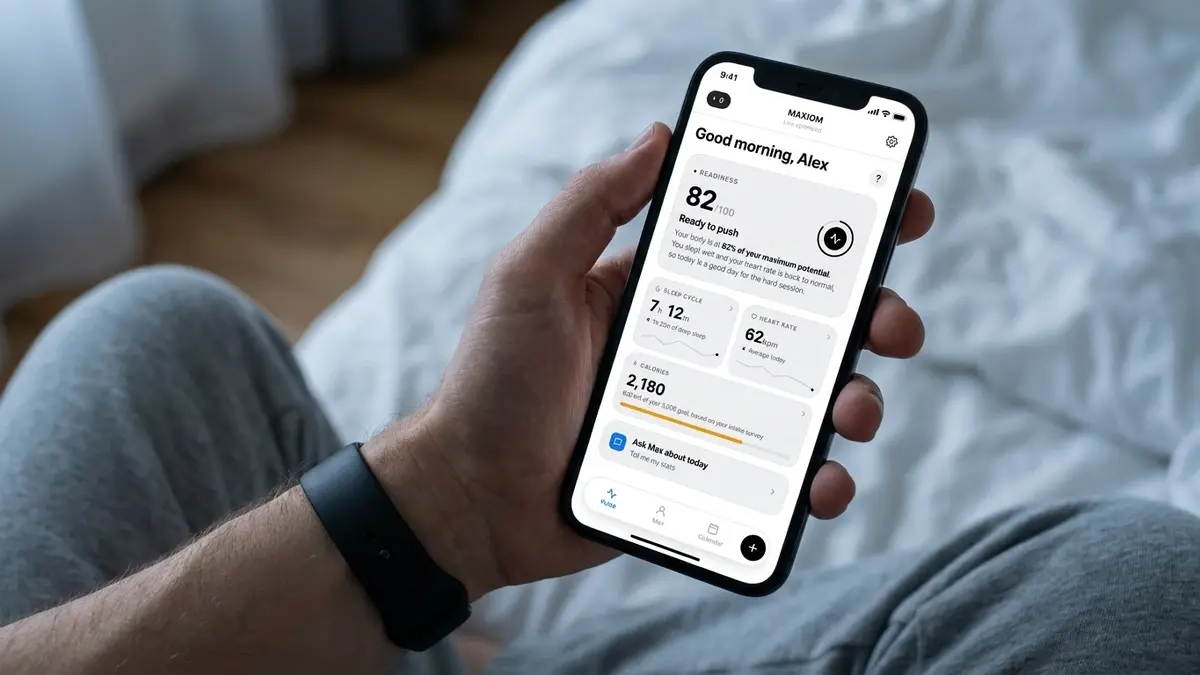
Pulse is the tab in the Maxiom app that turns your wearable data into one clear picture of how your body is doing today. It reads your heart rate variability, your sleep and your calories, then combines them into a single score from 1 to 100 called Body's Maximum Potential. Max AI, the coach inside Maxiom, uses that score to adjust your workouts and meals and to explain what changed.
In one line: Pulse = heart and recovery data + sleep + calories, combined into one score that Max acts on.
If your HRV is down, you slept five hours and you burned far more than you ate yesterday, Pulse shows a lower Body's Maximum Potential, and Max can ease your next session and adjust your meals to match.
Maxiom Pulse at a Glance
- What it is: the wearable data dashboard inside Maxiom, built around one daily score.
- What it tracks: heart rate variability, resting heart rate, steps, training load, sleep and calories.
- The score: Body's Maximum Potential, on a scale of 1 to 100. Higher means your body has more to give today.
- What Max does with it: he changes your workouts and meals, tells you why the score moved when you ask, and gives you a summary when you want one.
- Who can use it: every Maxiom user.
- What you need: a wearable connected to Maxiom. Pulse has nothing to read without one.
| Part of Pulse | What it shows | Why it matters |
|---|---|---|
| Heart and recovery | HRV, resting heart rate, steps and training load | How much stress your body is carrying and how well it is recovering |
| Sleep | How long you slept and how your night was spread across sleep stages | Most physical and nervous system recovery happens overnight |
| Calories | What you burned across the day | Whether your energy use and your eating are in line |
| Body's Maximum Potential | One score from 1 to 100 that combines the three above | A single answer to "how much can I ask of my body today?" |
What Is Pulse in Maxiom?
Most wearables give you a lot of numbers and very little direction. You get an HRV figure in one place, a sleep chart in another and a calorie ring somewhere else, and you are left to work out what they mean together.
Pulse puts those numbers on one screen and does the combining for you. It pulls the data your wearable already collects, groups it into three areas and then produces one score that sums up your day. You will also see it called Maxiom Pulse or Max Pulse. They are all the same feature.
The point of Pulse is not to give you more data. It is to give Max something reliable to coach from, so the advice you get reflects how your body is doing today and not how it was doing last month.
The Four Parts of Pulse
Pulse is made of three data areas and one score that sits on top of them.
Heart and Recovery
This is where your heart rate variability lives, along with resting heart rate, steps and training load.
- Heart rate variability: the small variation in time between heartbeats. A higher HRV than your usual generally points to a body that is rested and ready. Our guide to HRV by age explains what a normal number looks like.
- Resting heart rate: your pulse when you are fully at rest. A resting heart rate that creeps up over several days often means fatigue, stress or an illness coming on.
- Steps: your everyday movement outside of workouts.
- Training load: how much hard work you have put in recently, so Pulse can tell a tired body from an untrained one.
If you want to go further on heart metrics, recovery heart rate is a useful one to measure after hard sessions.
Sleep
Pulse reads your sleep cycle from your wearable, including how long you slept and how the night was split between light, deep and REM sleep. A long night with very little deep sleep does not restore you the way a balanced one does, which is why Pulse looks at the cycle and not only the hours. If your sleep chart confuses you, our guide to the stages of sleep walks through what each stage does.
Calories
Pulse tracks the calories you burn across the day. This matters for recovery as much as for weight. Train hard for a few days while eating too little and your HRV and sleep usually suffer next. Seeing calories next to your recovery data makes that link visible. If the numbers on your watch do not add up, read our explainer on active calories vs total calories.
Body's Maximum Potential
This is the part that pulls everything together. Body's Maximum Potential is a single score from 1 to 100 that reflects your heart and recovery data, your sleep and your calories at once. It answers one question: how much of your full capacity is available to you today?
How to Read Your Body's Maximum Potential Score
A higher score means your body is well recovered and can handle more. A lower score means something is holding you back, and it is a better day for lighter work.
Three things make the score more useful:
- Compare it to your own normal: Your usual range matters more than the number on its own. A score that is well below what you normally see is the signal to pay attention to.
- Watch the trend: One low day after a late night is expected. A score that keeps sliding for a week while your routine stays the same means your recovery is not keeping up.
- Do not chase 100: The score is a guide for planning your day. A lower score after a hard training block is your body doing exactly what it should.
When the score surprises you, you do not have to guess at the reason. That is where Max comes in.
How Max AI Works With Pulse
Max AI is the AI health and fitness coach inside Maxiom. Pulse is what he reads before he tells you what to do.
He adjusts your workouts: When your Body's Maximum Potential is low, Max can lighten or swap your next session. When it is high, he can let you push.
He adjusts your meals: If your calories and recovery are out of step, he changes what you eat to support the day you are having. This is the thinking behind adaptive recovery nutrition.
He explains why your score changed: Ask him why your score dropped and he will point to what moved, whether that was a short night, a fall in HRV or a heavy training week.
He gives you a summary when you ask: If you do not want to read each section, ask Max for a summary of your Pulse and he will give you the short version.
Because Max also keeps your goals, injuries and conditions in mind, the advice is built around you and not around an average user. We cover why that matters in why generic AI gives dangerous health advice.
What You Need to Use Pulse
Pulse is available to every Maxiom user. The one requirement is a wearable connected to Maxiom, because that is where the data comes from. Max connects with Apple Watch, Oura, Whoop, Garmin and Fitbit.
- Connect your wearable to Maxiom: Without a connected device, Pulse stays empty.
- Wear it day and night: Pulse needs both your daytime activity and your sleep to build the full picture.
- Open the Pulse tab: Check your Body's Maximum Potential and the three areas behind it.
- Ask Max about it: Ask him what your score means for today's workout and meals.
What Pulse Is Not
Pulse is a coaching tool, not a medical device. It works from wearable data, which is good at showing patterns and less reliable for any single reading. It cannot diagnose a condition. If you have symptoms such as chest pain, fainting or unusual shortness of breath, speak to a doctor and do not rely on a score.
The Short Version
Pulse is the part of Maxiom that reads your wearable and tells you how your body is doing today. It tracks heart and recovery data, sleep and calories, and combines them into Body's Maximum Potential, a score from 1 to 100. Max AI uses that score to adjust your workouts and meals, explains why it changed and summarises it on request. All you need is a connected wearable. To see your own score, open Maxiom and ask Max about your Pulse.
Frequently Asked Questions
What is Maxiom Pulse?
Maxiom Pulse is the tab in the Maxiom app that shows your wearable data in one place. It tracks your heart rate variability, resting heart rate, steps, training load, sleep and calories. It then combines them into a single score from 1 to 100 called Body's Maximum Potential. Max AI, the coach inside Maxiom, uses that score to adjust your workouts and meals.
What is Body's Maximum Potential?
Body's Maximum Potential is the main score in Maxiom Pulse. It runs from 1 to 100 and combines your heart and recovery data, your sleep and your calories into one number. A higher score means your body is well recovered and can handle more that day. A lower score means it is a better day for lighter training and more rest.
What data does Pulse use?
Pulse uses the data your wearable collects. That includes heart rate variability, resting heart rate, steps, training load, your sleep cycle and the calories you burn. Pulse groups these into three areas, which are heart and recovery, sleep and calories. It then uses all three to calculate your Body's Maximum Potential score.
Do I need a wearable to use Pulse?
Yes. Pulse only works when a wearable is connected to Maxiom, because all of its data comes from that device. Without one, there is no heart rate, sleep or calorie data for Pulse to read. Once your wearable is connected and you have worn it through the day and night, your Pulse tab fills in.
Which wearables work with Maxiom Pulse?
Max connects with Apple Watch, Oura, Whoop, Garmin and Fitbit. Pulse reads the heart rate, sleep and activity data these devices record. For the most complete score, wear your device during the day and while you sleep. Missing nights or long gaps without the device leave Pulse with less to work from.
Is Pulse free to use?
Pulse is available to every Maxiom user. It is not limited to a paid plan. The only requirement is a wearable connected to Maxiom, since Pulse cannot produce a score without wearable data.
How does Max AI use my Pulse score?
Max reads your Pulse data before he coaches you. When your Body's Maximum Potential is low, he can lighten your next workout and adjust your meals to support recovery. When it is high, he can let you train harder. You can also ask him why your score changed or ask for a summary of your Pulse, and he will answer using your own data.
Why did my Pulse score drop?
A lower Body's Maximum Potential usually traces back to one of the areas Pulse tracks. Common causes are a short or broken night of sleep, a fall in heart rate variability, a raised resting heart rate or several hard training days in a row. Eating too little for the amount you are burning can also pull it down. Ask Max and he will tell you which of these moved for you.
Is Max Pulse the same as a readiness or recovery score?
It is a similar idea with a wider view. Readiness and recovery scores on most wearables focus on sleep and heart data. Body's Maximum Potential in Maxiom Pulse also takes your calories into account, and it sits inside an app with a coach. That means Max does not only show you the score, he changes your workouts and meals based on it.