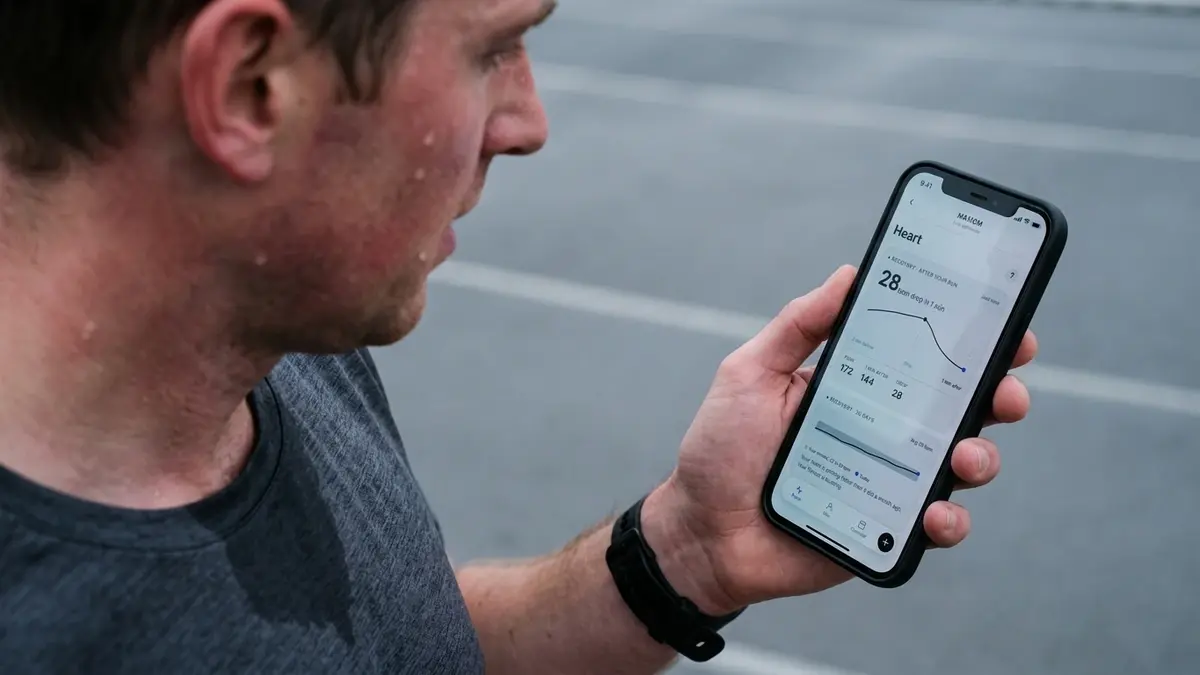
Recovery heart rate is the number of beats your heart rate drops in the first minute or two after you stop exercising. You work it out by taking your heart rate at the end of a hard effort and subtracting your heart rate 60 seconds later. A bigger drop means your heart and nervous system settle faster, which is a sign of better cardiovascular fitness.
The formula: recovery heart rate = heart rate when you stop − heart rate one minute later.
If you finish an interval at 172 bpm and you are at 144 bpm a minute later, your recovery heart rate is 28 bpm.
Recovery Heart Rate at a Glance
- What it is: the drop in heart rate after exercise, usually measured at one minute and sometimes at two.
- What is good: for most healthy adults, a one minute drop of 18 bpm or more is solid. Fit people often see 25 to 40 bpm or more.
- What is low: a drop of 12 bpm or less after one minute is the cutoff researchers use for abnormal recovery when you keep moving gently during the cool down.
- What it tells you: how quickly your body switches from effort back to rest. It reflects both fitness and how recovered you are today.
- What matters most: your own trend over weeks, measured the same way each time. One reading on its own says very little.
| One minute drop | What it usually means |
|---|---|
| 12 bpm or less | Slower than expected. Worth raising with a doctor if it keeps showing up |
| 13 to 17 bpm | On the lower side. Common if you are new to training, tired or dehydrated |
| 18 to 24 bpm | Healthy range for most adults |
| 25 to 40 bpm | Good to very good. Typical of people who train regularly |
| Over 40 bpm | Excellent. Common in well trained endurance athletes |
These bands are a practical guide, not a medical standard. Only the 12 bpm cutoff comes from clinical research, and that was measured under controlled test conditions.
Recovery Heart Rate, Heart Rate Recovery and Cardio Recovery Are the Same Thing
You will see three names for this metric. Researchers call it heart rate recovery, or HRR. Coaches and gym charts tend to say recovery heart rate. Apple Watch calls it Cardio Recovery. They all describe the same drop.
It is easy to mix it up with two other numbers:
- Resting heart rate is your pulse when you are fully at rest, usually measured overnight or first thing in the morning.
- Heart rate variability is the tiny variation in time between beats. It is a rest and recovery signal too, but it is measured while you are still. Our guide to HRV by age covers it in detail.
Recovery heart rate is the only one of the three that you measure straight after effort, which is why it tells you something the other two cannot.
Why Your Heart Rate Drops After Exercise
During hard exercise, your sympathetic nervous system is in charge. It pushes your heart rate up to deliver more oxygen to working muscles. The moment you stop, the parasympathetic side, the one that handles rest, starts taking back control.
That handover happens in two phases. The first minute is the fast phase, driven mostly by the parasympathetic system switching back on. After that comes a slower phase, as stress hormones clear and body temperature comes down.
This is why the first minute matters so much. A fast early drop shows that your nervous system can change gears quickly. A sluggish one suggests your body is struggling to come down from effort, either because your aerobic fitness is low or because something is weighing on your recovery that day.
What the Research Says
The best known study on this was published in the New England Journal of Medicine in 1999. Researchers followed 2,428 adults for six years after an exercise test. People whose heart rate dropped 12 bpm or less in the first minute were at clearly higher risk of dying during the follow up, even after accounting for age, fitness and other risk factors.
Later work backed this up. A 2017 analysis in the Journal of the American Heart Association pooled several long term studies and found that slower heart rate recovery was linked to a higher risk of cardiovascular events and death from any cause.
Two things are worth keeping in mind when you read numbers like these:
- The studies used supervised treadmill tests taken to a hard effort, with a set cool down. A reading from your watch after a casual jog is not the same test.
- The findings describe risk across large groups. They do not diagnose anything in one person. A low number is a reason to pay attention, not a reason to panic.
How to Measure Recovery Heart Rate Properly
Most of the confusion around this metric comes from measuring it differently each time. Use the same routine and your numbers become comparable.
- Get your heart rate up properly: Aim for a hard effort, around 80 to 90 percent of your maximum, held for at least a few minutes. An easy session will not give a useful reading.
- Note your heart rate the moment you stop: This is your peak number.
- Do the same cool down every time: Either stand still or walk slowly. Pick one and stick with it, because sitting or lying down makes your heart rate fall faster and inflates the result.
- Check your heart rate at exactly 60 seconds: Subtract it from the peak. For a second data point, check again at two minutes.
- Log it: One reading is noise. Five or six readings from similar workouts start to show a pattern.
What Your Wearable Does
Wearables handle this slightly differently, so check which version yours reports.
- Apple Watch shows Cardio Recovery in the Health app. It uses the drop in the first minute after you end a workout.
- Garmin shows a recovery heart rate based on the drop two minutes after you stop the activity timer, so its numbers are naturally higher.
- Chest straps are the most accurate option during hard efforts, when wrist sensors can lag behind fast changes.
A common mistake is ending the workout on your watch and then carrying on walking fast, or ending it several minutes after you actually stopped. Both give you a number that means nothing. End the workout when the effort ends.
What Affects Your Recovery Heart Rate
Your number moves from day to day. These are the usual reasons.
- Aerobic fitness: This is the biggest long term driver. The fitter your heart, the faster it settles.
- Age: Recovery heart rate tends to slow with age, much like maximum heart rate does.
- Sleep: A short or broken night leaves your nervous system less able to switch back to rest. If your sleep data confuses you, our guide to the stages of sleep explains what your tracker is showing.
- Hydration and heat: When you are dehydrated or training in hot conditions, your heart has to work harder to cool you down, so it stays elevated longer.
- Accumulated fatigue: A slower drop than usual after a normal session can be an early sign you are doing too much.
- Alcohol, caffeine and illness: All three can keep your heart rate up after exercise.
- Medications: Beta blockers and some other heart and blood pressure medicines change how your heart rate responds to exercise. Ask your doctor how to read your numbers if you take them.
- How hard you went: The higher your peak, the more room there is to drop. Compare like with like.
How to Improve Your Recovery Heart Rate
You cannot train recovery heart rate directly. It improves as a side effect of a fitter heart and a better rested body.
Build your aerobic base: Steady, comfortable cardio that you can hold a conversation through is what strengthens the heart over time. Three or four sessions a week is enough to see change.
Add one or two interval sessions: Short hard efforts with recovery periods in between teach your heart to come down quickly. They are, in effect, practice for the exact thing you are measuring.
Cool down instead of stopping dead: A few minutes of easy movement after a hard session helps your body shift back to rest more smoothly.
Protect your sleep: Most of the nervous system recovery that shows up in this number happens overnight.
Stay hydrated and eat enough: Under fuelling around hard training slows recovery across the board. If you are tracking energy, it helps to understand the difference between active calories and total calories before you set targets.
Do not ignore a falling trend: If your recovery heart rate is getting worse over two or three weeks while your training stays the same, take a lighter week. That pattern usually points to fatigue, poor sleep or an illness coming on.
Expect meaningful change to take six to twelve weeks of consistent training. Beginners often improve fastest.
When a Low Recovery Heart Rate Is Worth Checking
A single low reading after a rough night or a hot run is nothing to worry about. Speak to a doctor if:
- Your one minute drop is regularly 12 bpm or less, measured properly after hard efforts.
- Your number has fallen sharply with no obvious reason and stays down.
- You have chest pain, unusual shortness of breath, dizziness, fainting or palpitations during or after exercise.
A wearable can flag a pattern. It cannot diagnose a heart condition, and a proper exercise test with a clinician is the only way to get a reliable clinical reading.
Where Max AI Fits In
The hard part of recovery heart rate is not the maths. It is working out why your number changed and what to do about it today.
Max AI is the AI health and fitness coach inside Maxiom. He connects with Apple Watch, Oura, Whoop, Garmin and Fitbit, so he can read your heart rate, sleep and training data side by side. When your recovery is slower than usual, he can check it against how you slept, how hard you have trained that week and what you have eaten, then compare it to your own baseline instead of a population chart.
He also acts on it. If the pattern points to fatigue, he can ease your next session and adjust your meals to match, which is the idea behind adaptive recovery nutrition. And because he keeps your conditions, injuries and medications in mind between conversations, you are not getting the same generic list a chatbot would give anyone. We explain why that matters in why generic AI gives dangerous health advice.
If you want your numbers explained in the context of your own body, start with Maxiom and ask him about your last workout.
The Short Version
Recovery heart rate is how far your pulse falls in the minute after hard exercise. Eighteen bpm or more is healthy for most adults, 12 or less is the level researchers flag, and fitter people recover faster. Measure it the same way every time, watch the trend instead of single readings, and improve it the same way you improve fitness in general: steady cardio, some intervals, good sleep and enough rest.
Frequently Asked Questions
What is a good recovery heart rate after one minute?
For most healthy adults, a drop of 18 bpm or more in the first minute after hard exercise is a good sign. People who train regularly often see 25 to 40 bpm, and well trained endurance athletes can go higher. A drop of 12 bpm or less is the level researchers treat as abnormal when the cool down is active. These ranges are a guide, so the more useful comparison is your own number over time.
How do I calculate my recovery heart rate?
Take your heart rate at the moment you stop a hard effort, then take it again exactly one minute later. Subtract the second number from the first. If you stop at 170 bpm and you are at 145 bpm a minute later, your recovery heart rate is 25 bpm.
Keep the routine the same each time. Use a similar workout intensity and the same cool down, either standing or walking slowly, so your readings can be compared.
Is recovery heart rate the same as resting heart rate?
No. Resting heart rate is your pulse when you are completely at rest, usually measured during sleep or just after waking. Recovery heart rate is how many beats your pulse drops in the minute or two after exercise. Both tend to improve as you get fitter, but they measure different things. Resting heart rate shows your baseline, while recovery heart rate shows how quickly your body can come back down from effort.
Does recovery heart rate change with age?
Yes. Recovery heart rate generally slows as people get older, in the same way that maximum heart rate falls with age. The decline is gradual, and regular aerobic exercise slows it considerably. An active 55 year old can easily recover faster than an inactive 30 year old. This is why comparing yourself to your own past readings is more useful than comparing yourself to an age chart.
Why is my recovery heart rate worse than usual today?
A slower drop than normal usually comes down to something specific about that day. Poor sleep, dehydration, heat, alcohol the night before, caffeine, or an illness starting can all keep your heart rate elevated after exercise. It can also mean you have not recovered from recent training.
One off day is not a concern. If the number stays down for two or three weeks while your training has not changed, treat it as a sign to rest more and look at your sleep.
How long does it take to improve recovery heart rate?
Most people see a clear improvement within six to twelve weeks of consistent aerobic training. Beginners tend to improve fastest because they have the most room to gain. The most effective mix is steady, moderate cardio several times a week plus one or two interval sessions. Sleep, hydration and enough rest between hard sessions matter just as much, because recovery heart rate reflects how rested you are as well as how fit you are.
Why does my Apple Watch show a different number from my Garmin?
They measure different time windows. Apple Watch reports Cardio Recovery as the drop in the first minute after you end a workout. Garmin reports the drop two minutes after you stop the timer, so its figure is usually higher for the same session. Neither is wrong. Pick one device, measure the same way each time and follow the trend on that device only.
Should I worry if my recovery heart rate is under 12?
Not from a single reading. Wrist sensors can lag, and tiredness, heat or a workout that was not hard enough can all produce a low number. If your one minute drop is regularly 12 bpm or less after proper hard efforts, it is sensible to mention it to a doctor, since research links slow recovery to higher cardiovascular risk.
See a doctor promptly if a low number comes with chest pain, dizziness, fainting or unusual breathlessness.
Can Max AI help me understand my recovery heart rate?
Yes. Max AI is the AI coach inside Maxiom, and he reads data from Apple Watch, Oura, Whoop, Garmin and Fitbit. He looks at your heart rate alongside your sleep, training load and nutrition, so he can explain why your recovery changed and compare it to your own baseline. He also keeps your conditions, injuries and medications in mind, and adjusts your workouts and meals when your body needs more recovery.