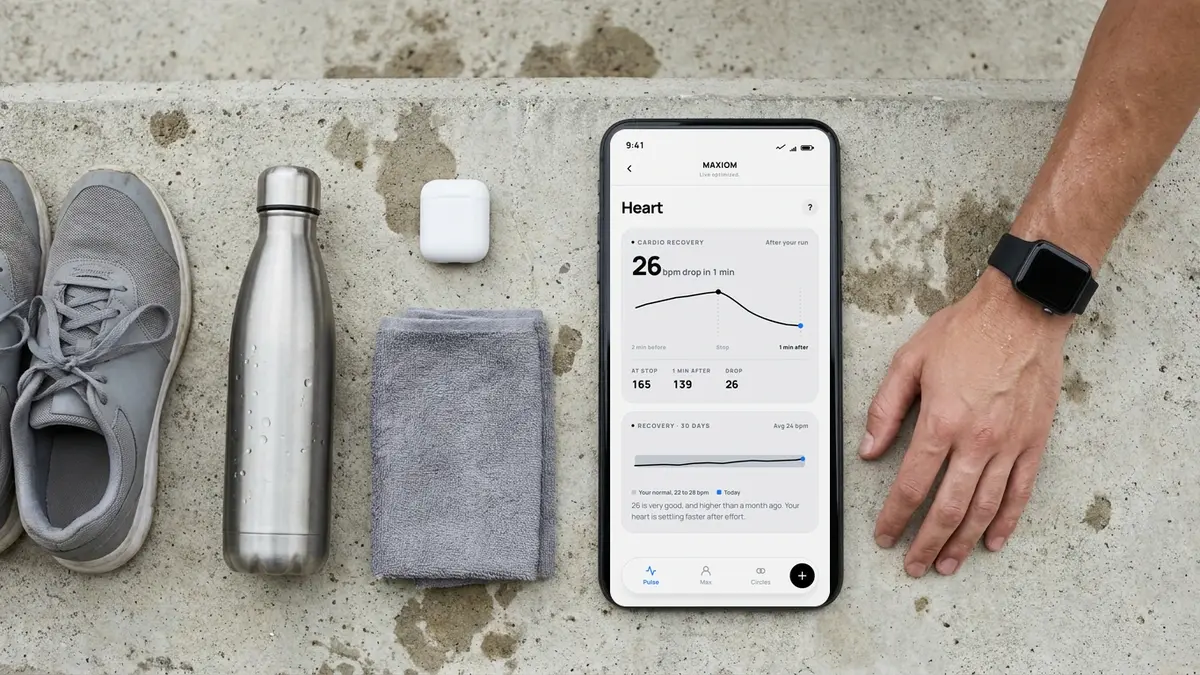
Cardio Recovery on Apple Watch is how many beats per minute your heart rate drops in the first minute after you end a workout. Higher is better. For most healthy adults, a one minute drop of 18 bpm or more is good, 25 to 40 bpm is very good, and over 40 bpm is excellent. A drop of 12 bpm or less is the level researchers treat as slow.
The formula: Cardio Recovery = heart rate when you end the workout − heart rate one minute later.
If you end a run at 165 bpm and your watch reads 139 bpm a minute later, your Cardio Recovery is 26 bpm, which is a good result.
Cardio Recovery at a Glance
- Is higher or lower better? Higher. A bigger drop means your heart settles faster after effort.
- Good: 18 bpm or more after one minute.
- Very good: 25 to 40 bpm, common in people who train regularly.
- Excellent: over 40 bpm, typical of well trained endurance athletes.
- Slow: 12 bpm or less, which is worth raising with a doctor if it keeps showing up.
- What matters most: your own trend after similar workouts, not one reading.
Is My Cardio Recovery Good? Number by Number
Find your number below. These are one minute values, which is what Apple Watch reports as Cardio Recovery.
| Your Cardio Recovery | Is it good? |
|---|---|
| 12 bpm or less | Slow. Check how you measured it, and speak to a doctor if it stays here |
| 13 to 17 bpm | On the low side. Common if you are new to training, tired or dehydrated |
| 18 bpm | Good. This is the usual benchmark for a healthy drop |
| 20 bpm | Good |
| 22 bpm | Good |
| 24 bpm | Good, close to the range regular exercisers see |
| 25 bpm | Very good |
| 26 bpm | Very good |
| 27 bpm | Very good |
| 28 bpm | Very good |
| 29 bpm | Very good |
| 30 bpm | Very good |
| 31 to 35 bpm | Very good, a sign of solid aerobic fitness |
| 36 to 39 bpm | Very good, near the top of the range for most adults |
| 40 bpm or more | Excellent. Common in well trained endurance athletes |
These bands are a practical guide, not a medical standard. The 12 bpm cutoff comes from clinical research, and the 18 bpm benchmark is widely used by cardiologists. Everything in between depends on your age, fitness, medications and how hard the workout was.
Is Higher or Lower Cardio Recovery Better?
Higher is better. Cardio Recovery measures how far your heart rate falls, not how high it stays, so a bigger number means your heart is coming down from effort more quickly.
This is the opposite of resting heart rate, where lower is usually better. That is why the two are easy to mix up. If your Cardio Recovery number rises over weeks of training, your fitness is improving.
How Apple Watch Measures Cardio Recovery
When you end a workout in the Workout app, your Apple Watch keeps reading your heart rate for a few minutes afterwards. It compares your heart rate at the moment you ended the workout with your heart rate one minute later, and the difference is your Cardio Recovery. Apple renamed this metric from Heart Rate Recovery to Cardio Recovery in watchOS 9 and moved it into the Health app.
Where to find it: open the Health app on your iPhone, tap Browse, then Heart, then Cardio Recovery. On the watch, the Heart Rate app shows a post-workout section after you have done a workout that day.
The two minute number: the Health app also shows how far your heart rate fell after two minutes. This number is always larger. Some research uses a drop of about 22 bpm or less at two minutes as the sign of slow recovery, and fit people usually see well above that.
Why Your Number Might Be Wrong
Most strange readings come from how the workout ended, not from your heart.
- You ended the workout late: If you kept the workout running while you stretched or sat down, your heart rate had already dropped before the timer stopped. Your number will look low. As 9to5Mac explains, the watch needs to compare your true workout heart rate with the minutes right after it.
- You pushed hard in the last few seconds: A final sprint just before ending can skew the first minute.
- The workout was easy: If your heart rate never got high, there is not much room to drop.
- You changed what you did after: Sitting or lying down makes your heart rate fall faster than standing or walking, so pick one routine and keep it.
- The watch was loose: Wrist sensors lag during fast changes. Wear it snug for the workout and the minutes after.
The fix is simple. End the workout the moment the effort ends, then do the same cool down every time.
What a Low or High Number Means
A high number usually reflects good aerobic fitness and a nervous system that switches from effort back to rest quickly. Our guide to recovery heart rate explains the science behind that handover.
A low number on one day is rarely a concern. Poor sleep, dehydration, heat, alcohol, caffeine, an illness starting or a hard training week can all slow your recovery. If your sleep has been off, our guide to the stages of sleep shows what your watch is tracking overnight.
A low number that stays low is different. If your one minute drop is regularly 12 bpm or less after proper hard efforts, mention it to a doctor. A 1999 study in the New England Journal of Medicine linked that level of slow recovery to higher long term risk, though it used supervised treadmill tests, not a watch. Beta blockers and some other medicines also change how your heart rate responds to exercise.
See a doctor promptly if a low reading comes with chest pain, dizziness, fainting or unusual breathlessness.
How to Improve Your Cardio Recovery
Cardio Recovery improves as your heart gets fitter and your body gets better rested. You cannot train the number directly.
Build your aerobic base: Steady cardio you can hold a conversation through, three or four times a week, does most of the work.
Add one or two interval sessions: Short hard efforts with recovery in between train your heart to come down quickly.
Protect your sleep: Much of your nervous system recovery happens overnight. Your heart rate variability is a good daily check on how rested you are.
Eat enough for your training: Under fuelling slows recovery across the board. If you are tracking energy, learn the difference between active calories and total calories before you set targets.
Be patient: Most people see clear improvement within six to twelve weeks of consistent training.
How Max AI Reads Your Cardio Recovery
A number on its own only tells you so much. The useful question is why it changed and what to do about it today.
Max AI, the coach inside Maxiom, connects with Apple Watch, Oura, Whoop, Garmin and Fitbit. Through Pulse, he reads your heart rate, HRV, sleep, training load and calories together, so he can tell whether a slow recovery comes from a short night, a heavy week or not eating enough.
He compares your numbers with your own baseline for you, then tells you what your recovery should look like, why it is not there and what to change. If you need an easier day, he adjusts your next workout and your meals to match, which is the idea behind adaptive recovery nutrition. Because he keeps your conditions and medications in mind, a beta blocker or an old injury is part of his advice from the start. Think of him as a coach who is on your side, not a chart you have to decode.
If you want your Cardio Recovery explained in the context of your own body, start with Maxiom and ask Max about your last workout.
The Short Version
Cardio Recovery is how many bpm your heart rate drops in the minute after you end a workout on Apple Watch. Higher is better. Eighteen bpm or more is good, 25 to 40 is very good, over 40 is excellent and 12 or less is slow. End your workout the moment you stop, keep the same cool down each time and judge your trend over weeks, not one reading.
Frequently Asked Questions
What is a good cardio recovery on Apple Watch?
A one minute Cardio Recovery of 18 bpm or more is good for most healthy adults. People who train regularly often see 25 to 40 bpm, and well trained endurance athletes can go above 40. A drop of 12 bpm or less is the level researchers treat as slow. Your own trend after similar workouts matters more than any single number.
Is higher or lower cardio recovery better?
Higher cardio recovery is better. The number shows how far your heart rate falls in the minute after exercise, so a bigger drop means your heart settles faster. This is the opposite of resting heart rate, where lower is usually better. A cardio recovery that rises over weeks of training is a sign your fitness is improving.
Is 20 bpm cardio recovery good?
Yes. A one minute drop of 20 bpm is above the commonly used benchmark of 18 bpm, so it is a healthy result for most adults. It sits at the lower end of the good range, which is common if you are newer to training or the workout was moderate. Consistent aerobic exercise will usually push it higher over time.
Is 26 bpm cardio recovery good?
Yes, 26 bpm is a very good one minute cardio recovery. It is well above the 18 bpm benchmark and within the range most people who exercise regularly see. Numbers from 25 to 30 bpm point to solid aerobic fitness. Keep measuring after similar workouts to see whether it is holding steady or improving.
Is 30 bpm cardio recovery good?
Yes, a drop of 30 bpm in the first minute is a very good result. It suggests your heart and nervous system switch from effort back to rest quickly. Most numbers between 28 and 35 bpm reflect good cardiovascular fitness. Compare it with your own past readings to track progress.
Is 40 bpm cardio recovery good?
Yes, 40 bpm is an excellent cardio recovery. Drops at this level are common in well trained endurance athletes and people with high aerobic fitness. If you see a number this high after an easy workout, check that you ended the workout as soon as you stopped. Ending it late or pushing hard in the final seconds can make the reading look higher or lower than it really is.
What does it mean if my cardio recovery is low?
A single low reading usually comes from poor sleep, dehydration, heat, alcohol, an illness starting or ending the workout late. It is not a reason to worry on its own. If your one minute drop is regularly 12 bpm or less after hard efforts, speak to a doctor, since research links slow recovery to higher cardiovascular risk. Seek help promptly if a low number comes with chest pain, dizziness or fainting.
What is a good 2 minute heart rate recovery?
The two minute number is always larger than the one minute number, because your heart rate keeps falling. Some research treats a drop of about 22 bpm or less at two minutes as slow recovery. Fit, healthy adults usually see a drop well above that. Apple Health shows both values, but the one minute figure is the one most research uses.
Why is my Apple Watch cardio recovery different every day?
Cardio Recovery depends on how hard you worked, how you cooled down and how rested you were. A harder workout leaves more room for your heart rate to drop, and sitting down after the workout makes it fall faster than walking. Sleep, hydration, caffeine and recent training also move it. Compare readings from similar workouts with the same cool down to see your real trend.
Can Max AI explain my cardio recovery?
Yes. Max AI connects with your Apple Watch and reads your cardio recovery alongside your HRV, sleep, training load and calories. He compares it with your own baseline and tells you why it changed and what to do next. If you need more recovery, he adjusts your workouts and meals to match.