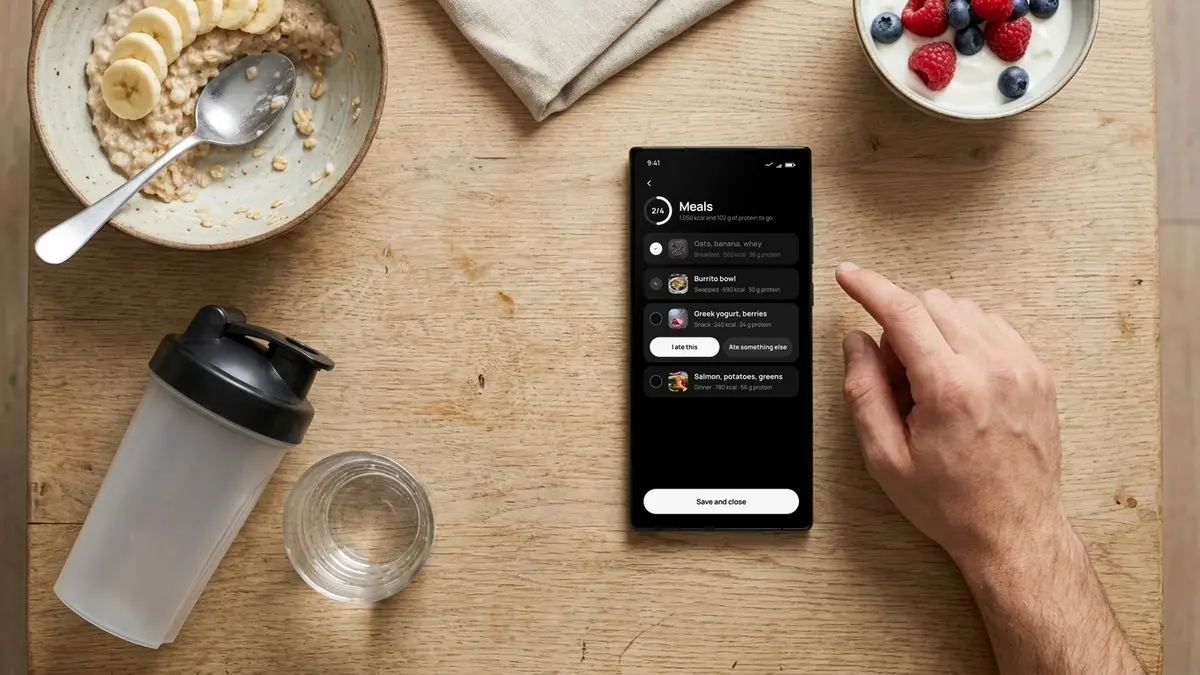
To track your calories, first work out how many calories your body uses in a day, then set a daily target based on your goal, and log everything you eat and drink against that target. Weigh or measure your portions for the first few weeks, log as you go instead of at the end of the day, and review your weekly average, not single days.
The basic equation: calories in − calories out = the direction your weight moves over time.
If your body uses about 2,300 calories a day and you eat around 1,800, you are in a deficit of roughly 500 calories, which usually leads to steady weight loss over several weeks.
How to Track Your Calories at a Glance
- Step 1: estimate how many calories you burn in a day, known as your total daily energy expenditure.
- Step 2: set a target. Eat below it to lose weight, at it to maintain, above it to gain.
- Step 3: log every meal, snack and drink, including oils, sauces and anything you taste while cooking.
- Step 4: measure portions with a food scale or measuring cups, at least for the first two to four weeks.
- Step 5: judge progress by your weekly average weight and intake, then adjust your target.
| Goal | Daily target compared to what you burn | What to expect |
|---|---|---|
| Lose weight | Around 300 to 500 calories below | Gradual loss you can keep up |
| Maintain weight | Roughly equal | Weight stays within a small range |
| Build muscle | Around 200 to 300 calories above, with strength training | Slow gain, mostly lean mass |
These ranges are a practical starting point, not a prescription. Your real needs show up in your weekly trend, which is why tracking matters.
Why Tracking Your Calories Works
Most people underestimate how much they eat. Portions grow, snacks get forgotten and drinks rarely get counted. Tracking makes those hidden calories visible.
The evidence for writing things down is strong. In a Kaiser Permanente study of nearly 1,700 adults, people who kept daily food records lost about twice as much weight as those who kept none. The researchers found that the habit of recording food was one of the best predictors of success.
Tracking also teaches you something a diet plan cannot. After a few weeks, you start to know roughly what a portion of rice, a coffee with milk or a restaurant meal costs you, and you make better choices without needing to log forever.
Step 1: Work Out How Many Calories You Burn
Your total daily energy expenditure, or TDEE, is the number of calories your body uses in a day. It has two main parts:
- Basal metabolic rate: the energy your body needs just to stay alive at rest, such as breathing, circulation and keeping warm. For most people this is the largest part.
- Activity: everything else, from walking and standing to workouts.
This is the same split your smartwatch shows as resting and active calories. If those numbers confuse you, our guide to active calories vs total calories explains exactly what each one includes and which to use when you set a target.
How to Calculate Your Calories
The Mifflin St Jeor equation is the formula most dietitians use to estimate basal metabolic rate:
- Men: (10 × weight in kg) + (6.25 × height in cm) − (5 × age) + 5
- Women: (10 × weight in kg) + (6.25 × height in cm) − (5 × age) − 161
Then multiply the result by your activity level:
| Activity level | Multiplier |
|---|---|
| Mostly sitting, little exercise | 1.2 |
| Light exercise one to three days a week | 1.375 |
| Moderate exercise three to five days a week | 1.55 |
| Hard exercise six to seven days a week | 1.725 |
| Very hard training or a physical job | 1.9 |
Example: a 30 year old woman who is 165 cm tall, weighs 70 kg and trains three to five times a week has a basal metabolic rate of about 1,430 calories. Multiplied by 1.55, her TDEE is about 2,220 calories a day.
Treat this as an estimate. Two people with the same numbers can burn different amounts, so your first two weeks of tracking are what tell you your real figure.
Step 2: Set Your Daily Calorie Target
Once you know roughly what you burn, set a target that matches your goal.
For weight loss: a deficit of around 300 to 500 calories a day is enough for most people to see steady progress without feeling drained. Bigger cuts often backfire. Energy, sleep and training suffer, and the plan becomes hard to stick to.
For maintenance: eat close to your TDEE and watch that your weekly average weight stays stable.
For muscle gain: a small surplus combined with strength training gives your body what it needs to build muscle without adding much fat.
Do not drop your intake very low without guidance from a doctor or registered dietitian, and if you have a history of disordered eating, speak to a professional before you start tracking at all.
Step 3: Log Everything You Eat and Drink
This is where most of the accuracy is won or lost.
- Log as you go: Record food when you eat it, not at the end of the day. Memory is unreliable, especially for snacks.
- Count drinks: Juice, coffee drinks, alcohol and smoothies can add several hundred calories without feeling like food.
- Count cooking fats: A tablespoon of oil is around 120 calories. It is the most commonly missed item.
- Include sauces and extras: Dressings, spreads, ketchup and the bites you taste while cooking all count.
- Choose accurate entries: Generic database entries can be wrong. Check the label or use a verified entry where you can.
Step 4: Measure Your Portions
Eyeballing portions is the biggest source of error in calorie tracking. A digital food scale is the single best tool you can buy for this.
- Weigh food raw where possible: Cooking changes weight as water is lost or absorbed, so raw weights are more consistent.
- Use measuring cups for liquids: Milk, oil and cereal are easy to over pour.
- Measure for two to four weeks: You do not need to weigh food forever. After a few weeks, your eye becomes far more accurate.
Food labels are not perfect either. They are allowed a margin of error, which is another reason to judge your results by the weekly trend.
Step 5: Track Your Calories Out Carefully
Many people track their intake accurately and then eat back every calorie their watch says they burned. That is one of the most common reasons progress stalls.
A Stanford study of seven wrist-worn fitness trackers found that heart rate readings were mostly accurate, but none of the devices measured calories burned well. The best was off by about 27 percent on average.
That does not make your wearable useless. It is very good at showing whether you were more or less active than usual. Just do not treat its calorie number as exact. Our guide to active calories vs total calories covers how to use these numbers without over-eating.
Step 6: Review Your Weekly Trend and Adjust
Daily weight jumps around with water, salt, hormones and digestion. A single day tells you very little.
- Weigh yourself at the same time each day: First thing in the morning, after the bathroom, works best.
- Look at the weekly average: Compare this week's average weight with last week's.
- Adjust slowly: If your average has not moved for two to three weeks and your logging has been accurate, lower your target by around 100 to 200 calories.
- Look beyond the scale: Energy, sleep, training performance and how your clothes fit all tell you whether the plan is working.
Common Calorie Tracking Mistakes
- Only logging the good days: Weekends and meals out often hold the calories that explain a stall.
- Eating back exercise calories: Wearable estimates often run high.
- Cutting too hard: Very low targets lead to hunger, poor sleep and rebound eating.
- Ignoring protein: Hitting your calories with very little protein makes it harder to stay full and keep muscle.
- Judging by one day: A heavy day after a salty meal is water, not fat.
- Ignoring sleep: Short sleep tends to increase hunger the next day. If your sleep is poor, our guide to the stages of sleep explains what your tracker is showing.
The Easiest Way to Track Your Calories: Maxiom and Max AI
Manual tracking works, but it asks a lot of you. You have to calculate your target, log every meal, work out which watch numbers to trust and decide what to change when progress slows. That last part is where most people give up.
Maxiom is built to take that work off you. Max, the AI health and fitness coach inside Maxiom, acts as your partner through the whole process.
He sets your target with you: Max works out your starting calories from your goal, body and routine, so you do not have to run the formula yourself.
He makes logging simple: Log your meals in the app and Max keeps the running total for the day, so you always know where you stand.
He reads your wearable for you: Maxiom connects with Apple Watch, Oura, Whoop, Garmin and Fitbit. Through Pulse, he sees your calories burned alongside your sleep and heart rate variability, and he knows not to take your watch's calorie number at face value.
He tells you what to change: When your weight stalls, Max looks at your intake, training, sleep and recovery together and explains why it is happening and what to adjust. If a hard training week means you need more food, he changes your meals to match, which is the idea behind adaptive recovery nutrition.
He looks out for you: Max keeps your goals, injuries, conditions and medications in mind, so his advice fits you and not an average person. He will tell you when you are cutting too hard, because the goal is progress you can keep, not the lowest number on a screen. We explain why that context matters in why generic AI gives dangerous health advice.
If you have tried a calorie counter before and found it all data and no direction, our comparison of the best MyFitnessPal alternative shows how a coaching app differs from a food diary.
The Short Version
To track your calories, estimate what you burn, set a target that matches your goal, log everything you eat and drink, measure your portions for the first few weeks and judge progress by your weekly average. Treat your watch's calorie number as a rough guide, not an exact figure. If you want a coach to do the maths, read your wearable data and tell you what to change, start with Maxiom and ask Max to set up your calorie target.
Frequently Asked Questions
How do I track my calories for the first time?
Start by estimating your total daily energy expenditure with a formula such as Mifflin St Jeor, then set a target based on your goal. Log every meal, snack and drink in an app as you eat it, including cooking oils and sauces. Use a food scale for the first few weeks so your portions are accurate. After two weeks, compare your weekly average weight with your intake and adjust.
How many calories should I eat a day?
It depends on your age, sex, height, weight and activity level. Most adults burn somewhere between about 1,800 and 3,000 calories a day, but individual needs vary widely. Calculate your own estimate, then eat around 300 to 500 calories below it to lose weight or close to it to maintain. Your weekly trend over the first few weeks shows your real number.
How do I keep track of my calorie intake without an app?
You can use a notebook or a note on your phone. Write down each food, the portion size and its calories from the label or a nutrition website, then add up the total at the end of the day. It works, but it takes more time and is easier to get wrong. An app saves you the maths and keeps a history you can review.
How accurate do I need to be when counting calories?
You do not need to be perfect, but you do need to be consistent. Small errors tend to balance out over a week, while repeated gaps such as forgotten snacks or unmeasured oil add up. Weigh your food for the first few weeks to learn what real portions look like. After that, careful estimates are usually enough.
Should I eat back the calories I burn from exercise?
Be careful with this. A Stanford study found that wrist-worn fitness trackers were often well off when estimating calories burned, even when their heart rate readings were accurate. If you eat back every exercise calorie your watch reports, you may cancel out your deficit. Eating back part of it, or setting your target from your total activity level instead, is safer.
What is the difference between active calories and total calories?
Active calories are the energy you burn through movement and exercise. Total calories add your resting energy, the calories your body uses just to keep running. When you set a daily target, total calories are the number that matters. Our guide to active calories vs total calories explains how wearables show each one.
Why am I not losing weight while counting calories?
The most common reasons are under-logging, especially oils, drinks and weekends, and eating back exercise calories that your watch overestimated. Water retention can also hide fat loss for a week or two. Check your weekly average weight over two to three weeks before changing anything. If it has not moved and your logging has been accurate, lower your target slightly.
Can Max AI track my calories for me?
Max helps you set your calorie target, keeps a running total of what you log and reads your calories burned from your connected wearable. He looks at your intake alongside your training, sleep and recovery data. When your progress slows, he explains why and adjusts your meals and workouts to match. He also keeps your goals, injuries and medications in mind so his advice fits you.